✔ Official MHADA Information
✔ Housing Projects
✔ Government Approved
✔ Scheme Details
📢 MHADA Nagpur Region – Important Notice:
आता लॉटरीशिवाय MHADA मध्ये घर बुक करू शकता अधिक माहितीसाठी व बुकिंगसाठी संपर्क करा: 73 73 73 4928 |
ईमेल: info@mahadagrihasevakendra.com
MHADA Housing Scheme Income Limits Explained
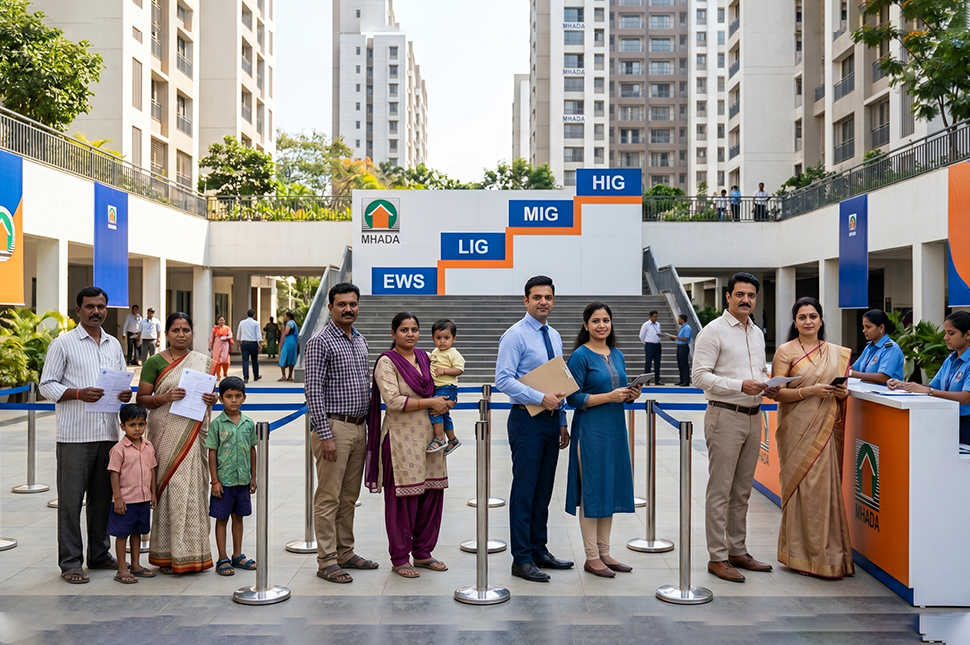
MHADA Housing Scheme Income Limits Explained
Income Limits for MHADA Housing Scheme Explained
The mhada housing scheme is designed to provide affordable housing opportunities to citizens across Maharashtra. One of the key eligibility factors in this scheme is the applicant’s annual income, which determines the housing category they can apply for. These income limits ensure fair distribution of homes among different sections of society.
This structured system helps government authorities identify the right beneficiaries and maintain transparency in the allotment process.
Income Categories in MHADA Housing Scheme
The mhada housing scheme classifies applicants into four main income groups based on annual earnings and affordability levels.
- EWS (Economically Weaker Section)
This category is for the lowest income group and is aimed at providing maximum affordable housing support under the scheme.
Applicants under EWS usually belong to families with very limited financial resources.
The focus is to ensure basic housing access at highly subsidized rates for this section.
This category plays a key role in inclusive housing development across Maharashtra.
- LIG (Low Income Group)
LIG includes applicants with low annual income who need budget-friendly housing options under government schemes.
These applicants may have stable but limited earnings, making affordability a major concern.
MHADA ensures that LIG families get access to safe and well-planned residential units.
This category bridges the gap between basic housing and mid-level affordability.
- MIG (Middle Income Group)
MIG is designed for middle-class families who can afford moderately priced homes with structured government support.
This group includes salaried professionals and small business owners.
MHADA provides well-developed housing options with better infrastructure in this category.
It helps middle-income families upgrade their living standards within budget.
- HIG (High Income Group)
HIG category is for higher-income applicants who are eligible for larger and premium housing units under the mhada housing scheme.
These applicants usually look for spacious homes with better amenities and locations.
Even in this segment, MHADA ensures regulated pricing and transparency.
This category supports balanced urban development across Maharashtra.
Why Income Limits Matter in MHADA Housing Scheme
Income limits ensure:
- Fair distribution of homes across all groups
- Transparent and structured allocation process
- Equal opportunity for affordable housing
- Proper classification of applicants
These rules help maintain balance between demand and availability in housing projects.
Documents Used for Income Verification
Applicants must submit valid income proof such as:
- Income Certificate from authority
- Salary slips or ITR documents
- Bank statements (if required)
These documents help verify eligibility and assign the correct category.
Proper documentation also speeds up the approval and verification process.
Conclusion
The mhada housing scheme uses a structured income-based system to ensure that every citizen gets a fair chance to own a home. Understanding these categories - EWS, LIG, MIG, and HIG helps applicants apply correctly and improves approval chances.
This system promotes transparency, fairness, and equal housing opportunities across Maharashtra.
Leave a Comment
Recent Blogs
-
 09 April, 2026
Documents Required for MHADA Housing Application
-
 09 April, 2026
MHADA Flat Booking Guide | Step-by-Step Process Explained
-
 09 April, 2026
MHADA AutoDCR | Full Form, Process & Benefits Explained
-
 09 April, 2026
MHADA Registration Process | Step-by-Step Guide
Comments on Post 0
No comments yet. Be the first to comment!